


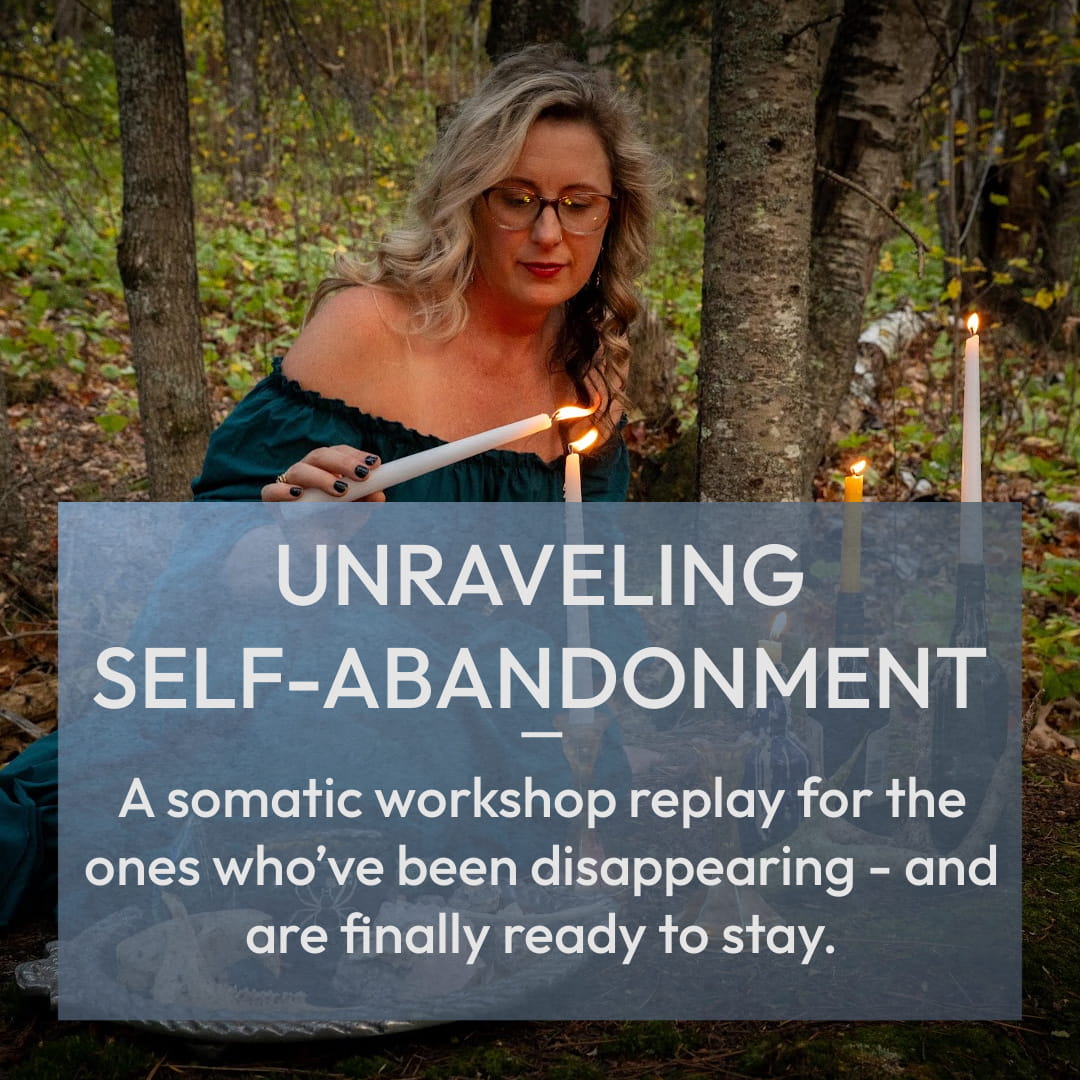
Unraveling Self-Abandonment – Replay
Suggested amount: $100.00
Last chance: this is the last time I’m selling this workshop
Somatic workshop replay
Unraveling Self-Abandonment
How and why and when do you still leave yourself?
It is safe to stay with myself now.
Name your price, $77 to $107 · suggested $100
You say yes when you mean no, and then you feel resentful later. You apologize to keep the peace, even when you’ve actually done nothing wrong. You know you’re hungry and you skip it, and you really need to pee but you make yourself hold it. You change your tone so you’re more digestible or liked. I’ll just become whoever you need.
Then there are the not-so-obvious ones. You smile and nod when you have a truth or a boundary or a need to name. You comfort someone who hurt you so they don’t have to feel guilty. You’re the one who tracks everybody’s emotions, the one who initiates every repair, and the only one going to therapy.
You’re probably so good at it that leaving yourself looks a whole lot like kindness, patience, strength, compassion, and selflessness to the people on the outside. But on the inside you’re resentful. Your body is tense, your voice gets weak, your breath is shallow, and your feelings, boundaries, needs, desires, and truth are buried underneath facial expressions, words, and actions that aren’t the real you.
Self-abandonment is trading parts of yourself for closeness and connection.
Why knowing better hasn’t stopped it
A lot of us were taught self-abandonment as manners. And the spirituality space, the dogma, the ideology, whatever you want to call it, keeps selling you the belief that your authentic self is always calm and regulated. Don’t buy it. So you pause to regulate yourself in the middle of a conflict, and you’re actually freezing. You say you’re managing your emotions, and you’re actually dissociating. And I think that being the bigger person thing is the biggest crock of bullshit any of us may have ever bought.
And your mind knows you’re out of the situation that taught you this, but your body hasn’t gotten the memo. So their breath changes, or their posture, or the way they look at you, and you flinch and adjust. You can try forcing confidence, thinking positively, and teaching yourself not to have needs. The pattern keeps running underneath all of it.
What you want
You want to stay with yourself, in the tension, with the truth. You want to keep your people close without trading pieces of yourself to do it.
I’m not sure if anybody’s ever told you this, but you are meant to rearrange rooms when you walk in them. That’s what authenticity does.
What this workshop gives you
It opens with a slow embodiment practice, because this workshop is about no longer leaving yourself. You find a place in your body that feels tense or unsafe or ick, and a place that already feels safe, maybe your pinky finger, and you ask each of them for 2%. And you get to notice that both can be there at the same time.
Then we get into the patterns. You don’t have to remember everything that happened to you to work on it in your life now, because I guarantee you the patterns are there regardless. We just have to teach the body that it is safe to stay with ourselves now. Have a pen and paper ready and jot down the ones that land, because you’ll write about one of them later. Here’s what’s in it:
- Why self-abandonment is a brilliant survival strategy, and when it becomes a problem
- The obvious forms, from saying yes when you mean no to apologizing when you’ve done nothing wrong
- The 10 not-so-obvious forms, the ones that hide in plain sight as regulation, being the bigger person, kindness, keeping the peace, emotional independence, and maturity, and what each one feels like in your body
- The even more subtle ones I’ve recently caught in myself
- How to tell whether you’re softening yourself out of love or out of fear
- How to name the sensation before you put the mask on, and how to feel the contraction of someone else’s discomfort without collapsing around it
- A guided writing exercise where you name a moment you left yourself, and then rewrite it as if you stayed
- A repair with the younger part of you who got left
It started as a brilliant strategy
We only abandon ourselves because we were first abandoned, probably emotionally, maybe even physically. So you got dropped, and now you drop yourself. A child can’t tolerate feeling fear and shame alone, so your body did what brilliant, efficient bodies do. It split, so you could soften and scan and fawn and turn the volume down on yourself to stay in connection with others. That is adaptive genius.
It becomes a problem when the strategy is the default, when it becomes who you think you have to be in order to belong or be loved or be safe or be connected.
The ones I still catch myself doing
No one in my adult life expects me to abandon myself. I’ve worked really hard to co-create relationships that are very welcoming of my authenticity. And I still catch myself doing it, in ways you’d never think were self-abandonment from the outside.
I speak the truth, but I round it off. I soften it a little bit. I hold back just a little bit of the edge. I tilt it one degree off center so it doesn’t sting them, even if allowing it to sting would be the medicine for both of us. I read the room before I decide how much of myself gets to show up, and I’m scanning for repercussions. I’m managing how the truth is received. It’s insanely fucking codependent.
I have Mars in Gemini, you guys. I’m literally a disruptor, and I wrap it in velvet and silk and pull the frequency back by 5 or 10%.
It’s why you’re doing it
When I first saw this in myself, I told some close friends about it over dinner at their house. They really love me, and they said, that sounds like empathy and kindness. Knowing someone’s overwhelmed and dialing back your delivery is a kind thing to do. And I realized that whether I’m modulating out of generosity and kindness, or because I’m afraid of being left, the other person’s experience of me is the same.
Later, when I finally had the words, I texted them: I do it because I’m bracing for them to leave the second I stop shaping myself to be tolerable.
So focus on why you’re doing it. Why are you softening your tone? Why are you dialing back your intensity? Why are you trying to appear regulated and calm? If the answer is anything but because that’s the most authentic thing I can do, you’re probably abandoning yourself and calling it maturity, love, kindness, regulation, generosity, or being the bigger person.
My oldest strategy
Self-abandonment is my oldest, most clever survival strategy. It’s the first thing I learned to do, before I had words for what I was doing, before I could name my feelings or my boundaries or my needs. I literally used to not get up and pee during church because I was afraid of being disruptive and being a distraction.
I’m a somatic relational witch and weaver and a complex PTSD educator, and in this workshop I lean on my favorite book in the world, Pete Walker’s Complex PTSD: From Surviving to Thriving. The rest is my own hard-earned lived experience.
What changes
This will put you on your knees more than anything else, because the risk is so high. And it happens in small moments. You pause before you say yes and ask, do I mean it? You notice the urge to make everyone comfortable and ask what comfort looks like for you. You speak a single completely true, unedited sentence, if that’s all you can manage to get out. You let the silence be there. You say I don’t know yet.
You will not catch them all. You will still drop yourself. The point is to start catching a moment, and then another, and then another, and to name what you feel and stay, even if it’s just a breath longer than you could stay before.
Questions you might have
What do I need to watch it?
A pen and paper, and a little quiet for the embodiment practice and the guided writing exercise.
What do I get?
The full workshop replay, with the embodiment practice and the guided writing exercise, plus my slides, so you can just be present. It’s yours for life.
Will it be available later?
This is the last time I’m selling it. Once this window closes, it won’t be for sale again.
What should I pay?
It’s name your price, $77 to $107. The suggested price is $100. Pick the number that fits your life right now. It’s the same workshop at every number.
What you get
- The full workshop replay, with the embodiment practice and the guided writing exercise
- My slides, so you can just be present and not even take notes
- Lifetime access
This is your last chance at it
This is the last time I’m selling UNRAVELING SELF-ABANDONMENT. If you buy it now, it’s yours for life. Once this window closes, it won’t be for sale again.
Name your price
$77 to $107
Suggested price: $100. Pick the number that fits your life right now. It’s the same workshop at every number.
