


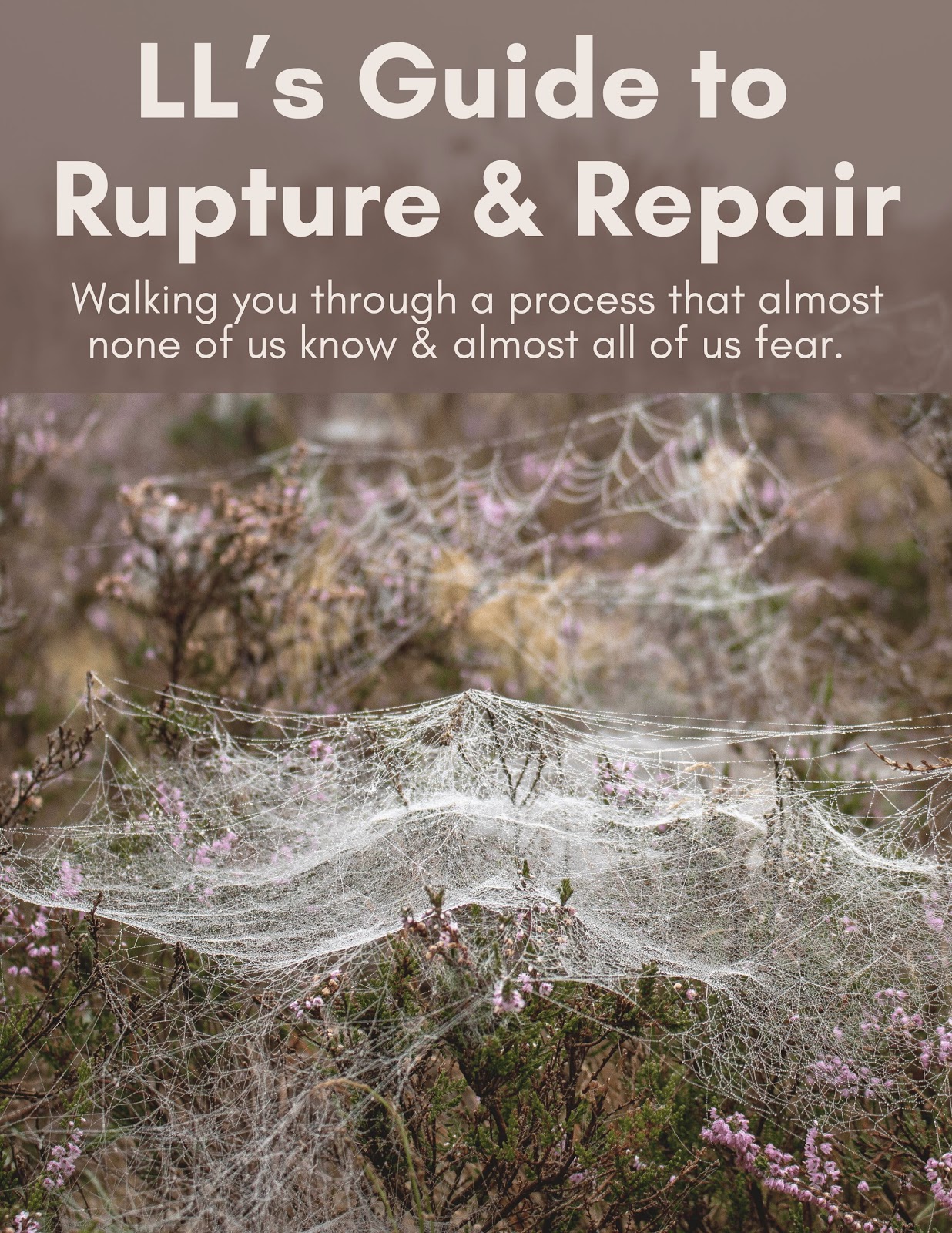
Guide to Rupture & Repair
Suggested amount: $17.00
eBook · 40 pages
LL’s Guide to Rupture & Repair
Walking you through a process that almost none of us know & almost all of us fear.
Relationships are the real work, and repair is the practice that makes relationships possible.
Name your price, $10 to $20 · suggested $17
When it comes to conflict, we all have some weird shit. We fear it. We avoid it. We stew over it in ourselves before we dare to bring it up to someone else. When someone says or does something that hurts, confuses, or activates us, we either don’t name it at all, or we talk about it with everyone except the person we have the rupture with.
Maybe your closest relationships just feel… off. There’s no outright abuse and no major betrayal. There’s an undercurrent of tension, a hesitation before speaking, a low-grade anxiety about saying the wrong thing, needing too much, being rejected, misunderstood, and abandoned.
So you over-text, over-apologize, and over-accommodate, and a delay in a response feels like rejection. Or you go quiet and become a fortress unto yourself. Or people have told you that you blame, deflect, defend, and shut down when they’re trying to talk about hard things with you.
Even in their closest relationships, most people are still bracing.
Why regulating yourself first hasn’t fixed it
For years, the dominant message in nervous system healing has been clear. Regulate yourself first. Learn to self-soothe. Build resilience on your own. The implied promise is that if you master individual regulation, relationships will naturally improve.
But healing doesn’t happen in a vacuum. The nervous system is a relational organ, shaped just as much by the people around us as by our own internal work. And these patterns live in the nervous system, which is primal, animal intelligence. It does not care about the quality of your relationships. It only cares about one thing: Will I survive this?
It’s not our fault that we were born into family systems and cultures that didn’t model healthy rupture and repair. Most of us never saw the adults in our lives engaging in real repair with each other or with us. So how would we know how to do it?
What you actually want
You want to name what’s real, stay with it even when it’s uncomfortable af, and come back to yourself and each other without abandoning yourself or harming someone else in the process. You want the kind of intimacy that can handle your real feelings and your actual, unedited truth. The kind that can handle a no, a disagreement, a rupture, a repair.
What this guide gives you
This is your guide to consciously weaving and repairing relational webs that hold authenticity, strength, and true connection. It’s for every relationship that matters to you, and it’s meant to be a steadying companion, something you can return to when the path gets tangled, when words fail, or when connection feels far away.
May it offer you language when your body forgets. May it offer you structure when your heart is tender. Inside the 40 pages:
- Pause & check your body. Your body always knows when something is off.
- What is the repair for? Do you want real connection or just relief from the discomfort?
- Gently name the rupture. Share impact, share your experience, and use “I” language.
- Listen. Like, really listen. Plus what to say when someone brings you a rupture and you don’t agree with their version of what happened.
- Own what’s yours. Owning your part is different from owning their feelings.
- Reweave together. It must be mutual, and it can’t be rushed.
- When repair isn’t possible. How to complete the cycle in your own body, with an internal repair practice for holding your own thread.
- When to NOT attempt repair: 6 red flags, including when someone weaponizes your vulnerability
- What to do when you’re both hurt, and how Sequencing lets you take turns so no one gets erased
- A language library for saying hard things, like when you’re still confused, when you need a boundary, and when you realize you messed up
- A mid-repair nervous system reset for when your body can’t keep up with the conversation
- How to share this guide with the people you love, with care and consent
- Reflection and integration questions to anchor the work in your real life
What a rupture is
A rupture is anything that causes disconnection, often subtle, sometimes overt, that interrupts the felt sense of safety, connection, clarity, or mutual regard. It can be a misunderstanding, a missed moment to notice or attune, a boundary crossed or never clearly expressed, a comment that landed with unintended impact, an unmet need, or a felt sense of “ouch, that hurt.”
Rupture is the inevitable result of being in real relationship. The goal is to recognize when it happens, stay with yourself, and build the skill of repair.
Repair means building a new thread that can hold what’s real.
You don’t have to be calm first
One common school of thought in the psychology and trauma space says that if your emotions aren’t expressed calmly, they’re invalid or dismissable. I do not agree with this perspective at all. It’s emotional perfectionism that penalizes people for having nervous systems.
Somatic truth sometimes shows up as shaky hands, tears, tone, a raised voice, and movement. Sometimes it comes out as anger, and that’s valid. Delivery matters. It just isn’t everything. My husband and I do not have a “no yelling” agreement, because we’ve both built the capacity in our nervous systems to express our own anger and to hold and witness each other’s.
And here’s the language I give you for bringing a hurt forward: Hey, you did this thing or said this thing. Here’s how I’m feeling about it. It hurts. Can we talk? If you’re approached like that and your response is anything other than “Absolutely, let’s talk about it. I’m listening,” you are the source of the conflict.
The real binary is suppression versus expression, performance versus truth, avoidance versus intimacy.
When you rush it
Sometimes repair gets rushed because someone feels anxious, ashamed, or desperate to fix it. They over-apologize, agree too quickly, or push for reconnection before either of you is ready. It’s a common survival strategy, and it pressures the other person to forgive and forget before they’ve processed what happened. It communicates, I need this to be over more than I need it to be real.
You can accept an apology and still need space. You can own your part and still choose distance. You can want repair and still move slowly.
Why I wrote it
I’m a Somatic Relational Weaver and a nervous system truth-teller, and my work has challenged mainstream psychology and trauma healing in some pretty big ways, especially my views on relational healing. As a 1/3 Emotional Projector in Human Design, I was quite literally built for this work.
And I’m in it with you. I have a lot of evidence that I misperceive communication cues and social cues, and when I’m not in awareness, I get lost in projection, assumption, and story. Many folks, myself included at times, mistake repair for proving who’s right and who’s wrong. Don’t get caught up in that cycle. It’s never-ending!
What changes
The familiar fight starts up again and one of you says, “Hey, we’re doing that thing we do again.” Said with awareness and without blame, a sentence like that creates enough space for both of you to pause, reorient, and choose something different. Your heart starts racing mid-conversation and you can say so: I care about this, and I need to take care of my nervous system before I say something I don’t mean.
Somebody tells you that you hurt them, and you can stay in the room even if you see it differently. And when someone won’t meet you, you complete the repair within yourself and stop replaying it. You do not need mutual closure to return to wholeness. Repair is relational, but healing is yours.
You are allowed to love someone and not repair with them. You are allowed to grieve what will never be repaired. You are allowed to stop reaching for connection that costs you integrity or that doesn’t reach back.
Questions you might have
What if the other person won’t repair with me?
That’s in here. The last of the 7 steps is what to do when repair isn’t possible, and how to complete it in your own body. There are also 6 red flags for when not to attempt repair at all.
Is it only for romantic relationships?
It’s for every relationship that matters to you: your partner, your mother, your best friend, your coworker.
Should the other person read it too?
You can read it on your own, or go through it one section at a time together. There’s a section on how to share it with the people you love without turning it into a weapon.
Do I have to be calm before I try to repair?
You don’t have to be calm first. You do need to be able to stay with yourself, and the guide shows you how, including a reset for when your body can’t keep up with the conversation.
What should I pay?
It’s name your price, $10 to $20. The suggested price is $17. Pick the number that fits your life right now. It’s the same guide at every number.
What you get
- The 40-page eBook as a PDF, yours to keep
- The 7-step repair framework, with examples of what to actually say
- The language library, the mid-repair reset, the internal repair practice, and the reflection questions
- Ready to download the moment you buy. Keep it on hand. Save it to your phone. Come back when shit hits the fan.
Name your price
$10 to $20
Suggested price: $17. Pick the number that fits your life right now. It’s the same guide at every number.
May your relationships be strong enough to rupture, and real enough to repair.
| Note: | Purchases are non-refundable. All sales final. |
|---|---|
| Waiver of liability: | Lindsey is NOT a licensed therapist, psychologist, or psychiatrist. She is a trauma educator and coach. Her work is not intended to take the place of medical care provided by the practitioner of your choice. It is also not intended to diagnose or treat any physical or mental illness or take the place of therapy provided by a credentialed therapist. Upon purchasing, you agree to these and all other Terms of Service at checkout, and you acknowledge the above statements and consent to working with Lindsey and/or using her products. |
